Trail Mix: Is A.I. Good For Backcountry Trippers?
A.I. is everywhere these days and you’re either already sick of it, or blissfully unaware how much it has leached into our daily lives. Whether that is a bad thing is still up for discussion, so let’s look in to it a little closer but first, let’s also set some ground rules…
There’s no “surprise” waiting for you at the end of the article where I announce I had A.I. write this entire thing. I’ve personally written every single article and gear review on this site for the past 15 years (aside from guest blogs and one particular April Fools joke on the matter which I’ll get to later). I feel writing the articles myself builds authenticity, and I have no plans to break that trust.
We’re not trying to purposely call anyone out for using A.I. for their content. That’s their personal choice, and in some cases, I fully support it.

Just type in where you’re headed and surely you’ll get there… and don't call me Shirley
So way back in 2023, artificial intelligence was just starting to ramp up and people were fearing the worst. Just a year prior Blake Lemoine, a senior software engineer in Google's Responsible A.I. organization resigned (later fired) because he believed that the company's LaMDA chatbot had achieved consciousness and was fully aware (although here we are four years later and A.I. is still spouting weird things to us such as putting glue on pizza so that the cheese would stick.). The time was ripe for a good April Fools joke so I made up the fake article announcing Canoe Route A.I., a bot that would plan an entire trip for you.
So here we are in 2026, and does such a thing finally exist? I can give a pretty solid “enhhh” to that as there are caveats… so many caveats.
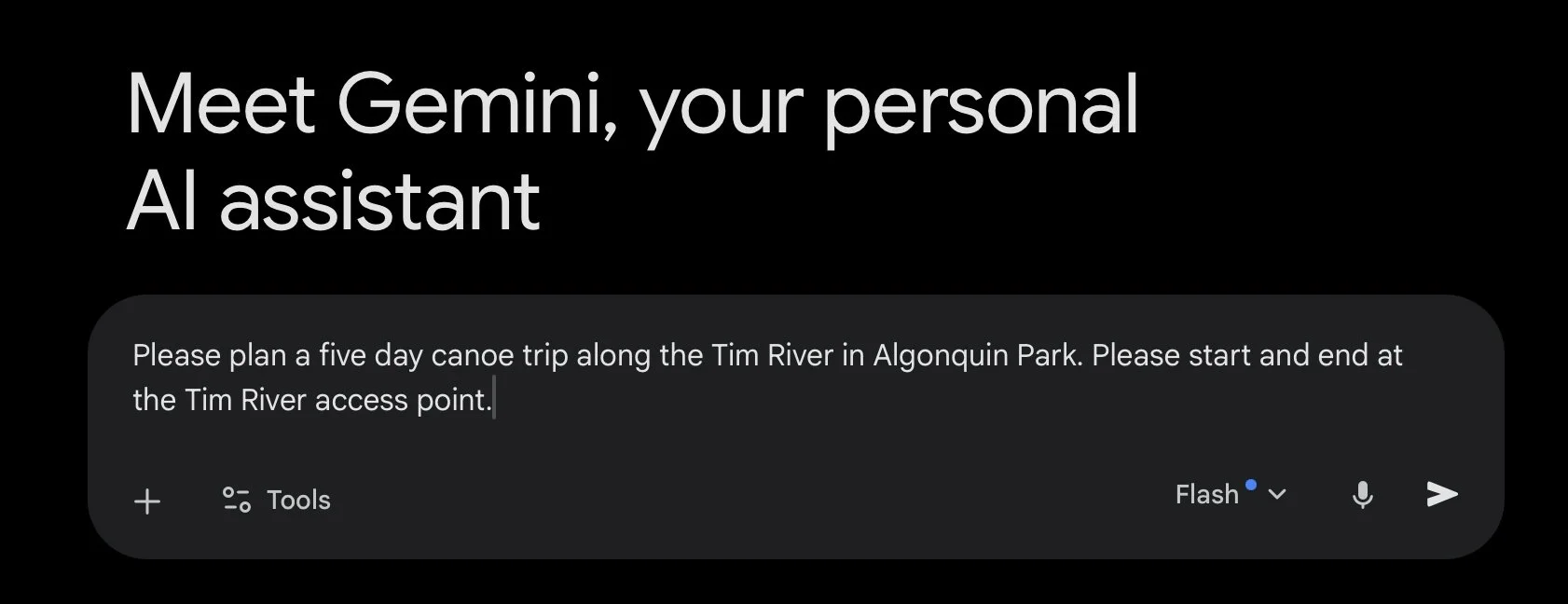
Asking Google Gemini to plan a five day trip along the Tim River in Algonquin Park only took it a few seconds to spit out an entire itinerary… [Tim River Access] -> Tim Lake -> Rosebary Lake -> Tim River (East) -> Shah Lake -> Misty Lake -> Little Misty -> Queer Lake -> Little Trout Creek / Tim River -> Tim Lake -> [Tim River Access].
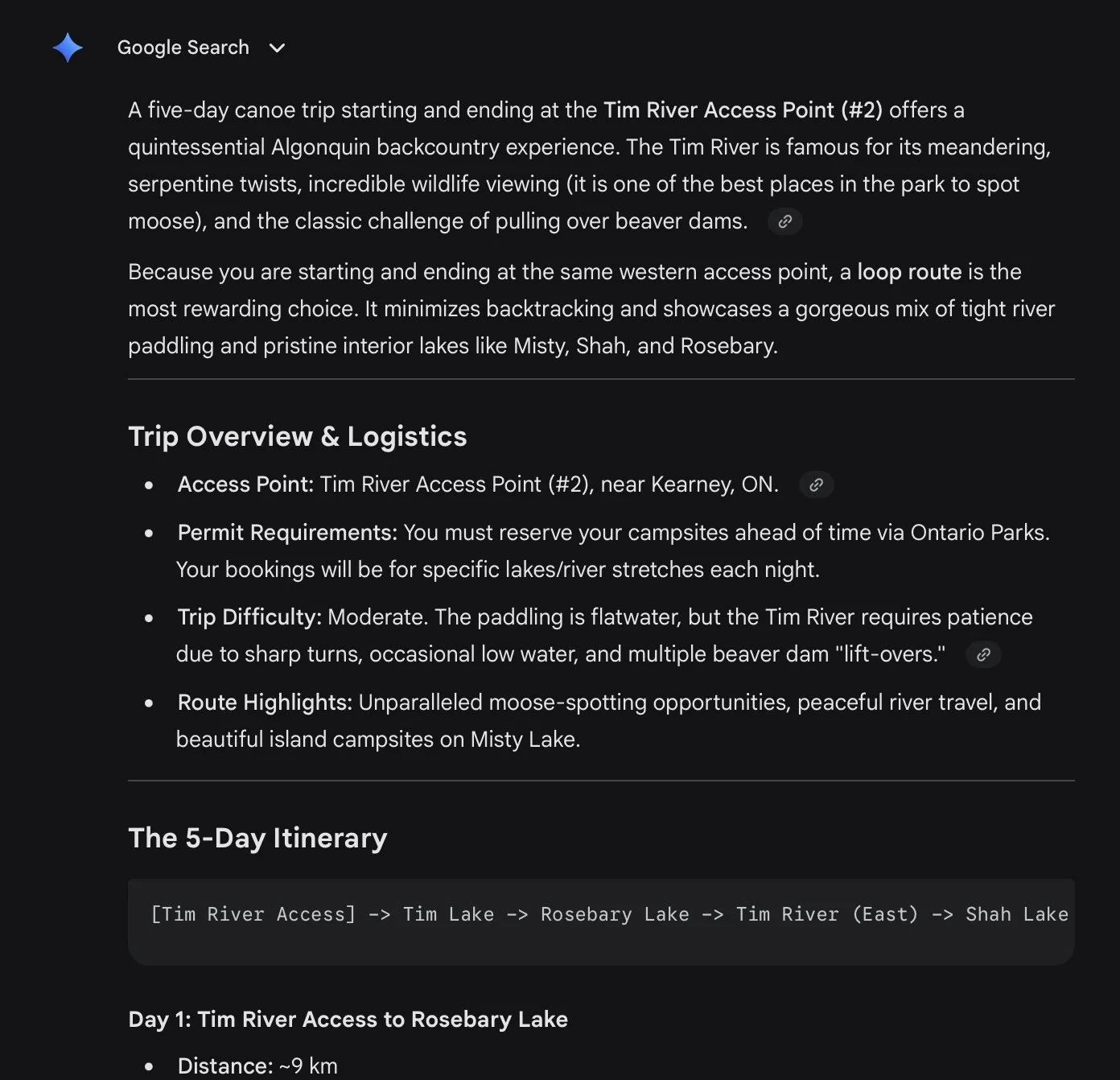
One aspect I do appreciate is when the A.I. lists its sources. In this case it scraped All of Algonquin and Voyageur Tripper, two fantastic resources that have a wealth of trip logs and first hand accounts of similar trips. The problem is, does anyone click the tiny button at the end of the A.I. generated article and then click through to their sites to learn more? Did Drew Czernik or Mikaela Ferguson see any traffic from the search and in turn hopefully have returning readership or even new subscribers? Probably less than when you would previously just type “Tim River canoe route” into Google and it would offer up links directly to their websites.
Drew’s trip reports are always an entertaining read, something that will definitely inspire you to trip more.
To further the issue in Mikaela’s case, some of that particular content is behind a paywall and she would be loosing out on subscriptions if the A.I. can find a sneaky way to access that content.
Further still, why miss out on the beautiful photos and stories that Drew spends hours writing to give you an entertaining read?
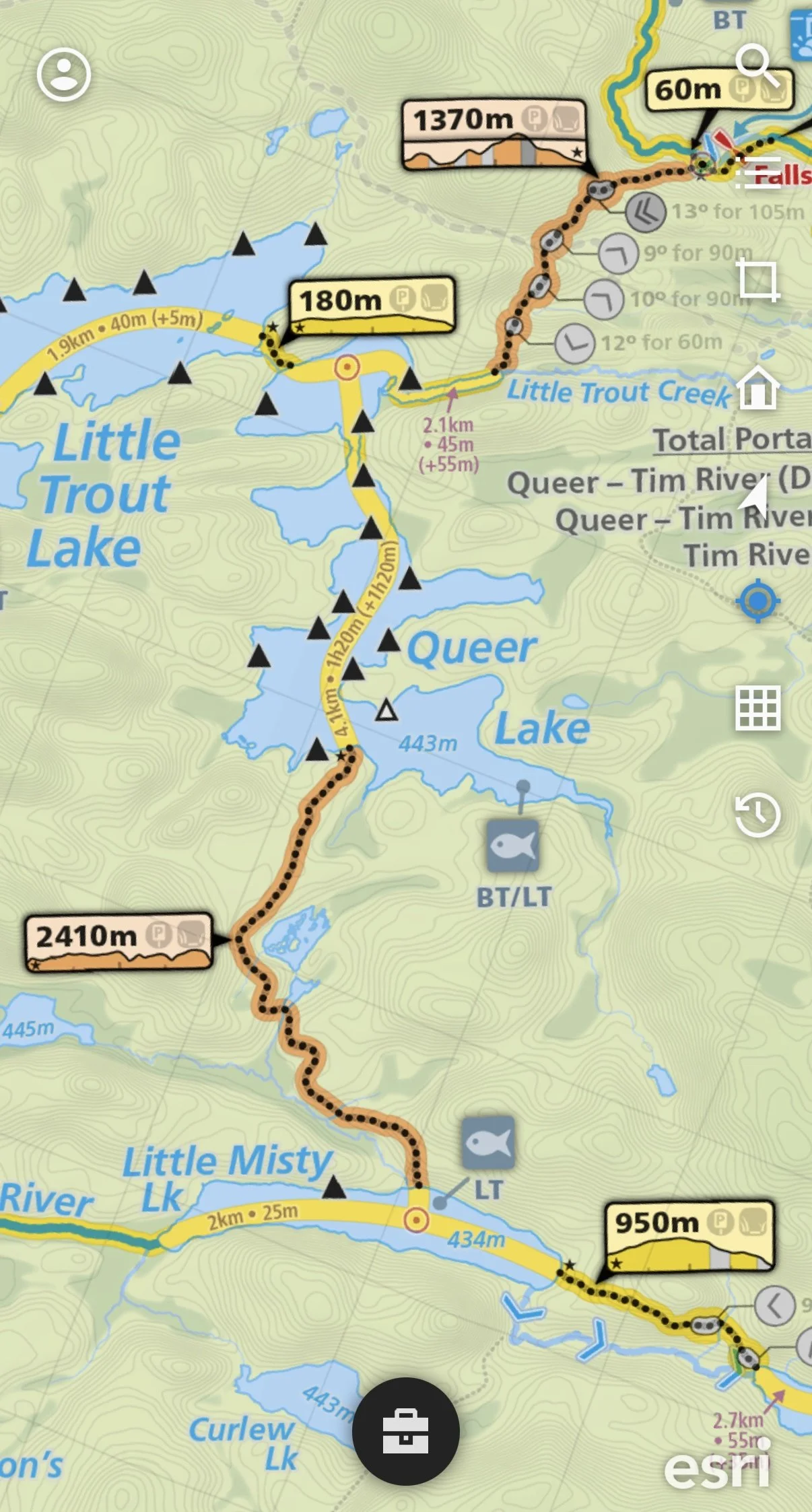
The Maps by Jeff Algonquin maps are the gold standard for tripping there, and now you can view them on ArcGIS.
And finally… is it accurate?
Well Day #1 of the itinerary is bang on including the proper access point and number of portages, but from there it goes off the rails.
In its attempt to create a succinct guide, it omits a 1,110m portage on day #2, and incorrectly mentions a 2.4k portage on day #3 as being a “short 175m stepover”. Even though it is a flat portage, incorrect information like that could really impact someone’s trip. There’s also a lot of inconsistencies in portage lengths of the smaller ones, but I’m willing to look past that for the time being.
I was impressed that it correctly highlights that the water levels are lower in the Autumn and that it has lots of lift-overs and muddy sections, something that might not be common knowledge to someone new to this route.
So, all of that to say… A.I. can definitely give you a route to try, but wouldn’t you have been better off just using a better resource? There’s no one fact checking A.I., or even a way to offer corrections or feedback so that it is better next time around. Sure you can point out errors, but there isn’t a curator that is verifying any of it is correct, or even if someone is just feeding it bad data. The data can also be out of date, so don’t expect any current conditions to be reflected such as fire bans, water levels or bug reports.
A.I. is very well suited for meal ideas and even recipes so I highly recommend giving that a try, but there’s a reason that pouring over a map is so much fun. It tickles your sense of adventure and forces you to learn new navigational skills such as using a compass. If you want a digital version, give Paddle Planner or the digital versions of Maps by Jeff a go.
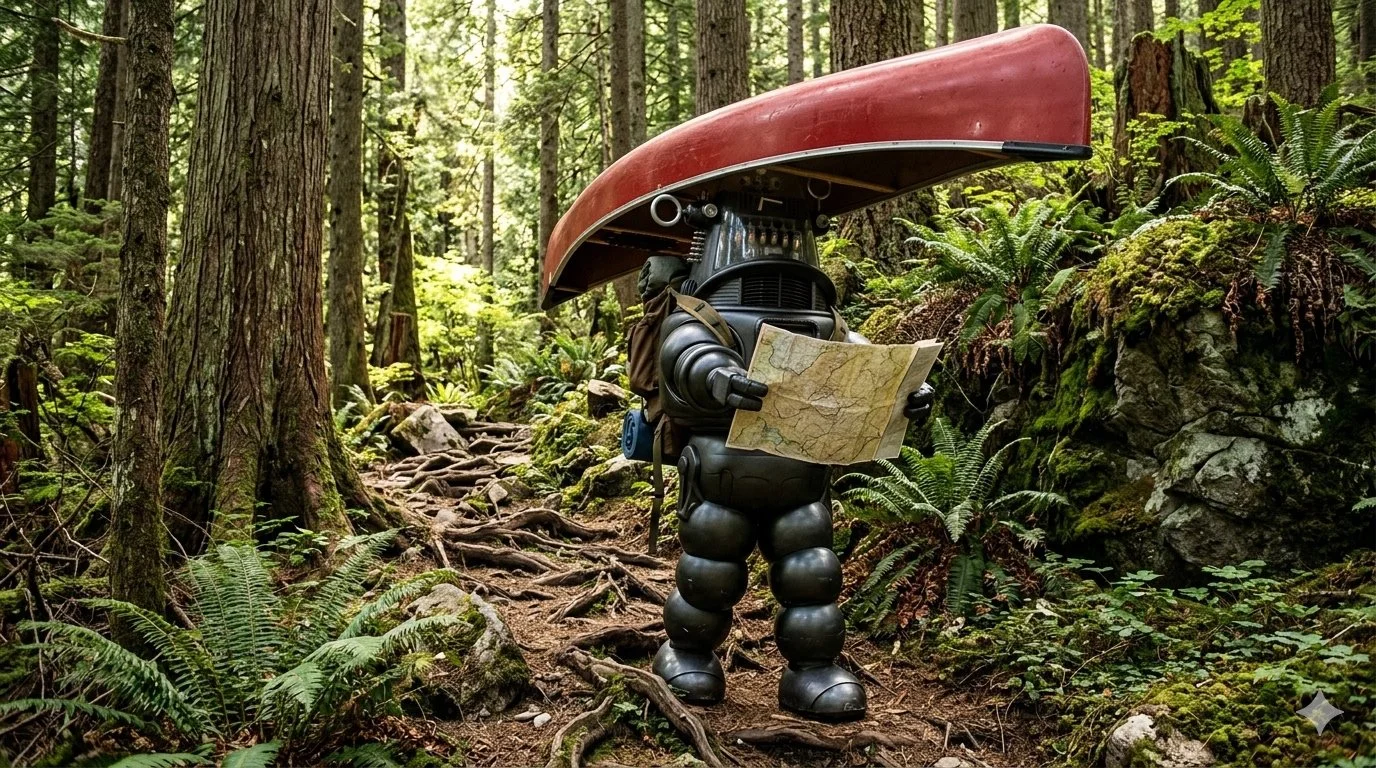
Poor Robby here won’t be able to navigate a route any time soon. So you might have to give up hope on a robot butler to portage your gear. (Yes, this image was created by A.I.)
But wait… there’s more…
A.I. (sick of me typing that yet?) is inherently good at creating content. Entire new avenues are now open to creators that would have taken a considerable amount of time and effort. There was a podcast that launched recently (I won’t mention who) by a group of legit canoeists, but each episode is hosted by two A.I. generated hosts. At first listen you might not notice as there is inflection in their voices, but after a while it might trigger that something is a little off. Odd audio garbles, a repeating back-and-forth banter that becomes tiring, and in the end, it makes you question if the entire episode wasn’t written by A.I. too. This even stretches into print media and you can be suspect of newer camping books that are self-published which sounds like a fear-mongering statement, but it doesn’t take much to dump an idea into the prompt and have it regurgitate chapters on your behalf.
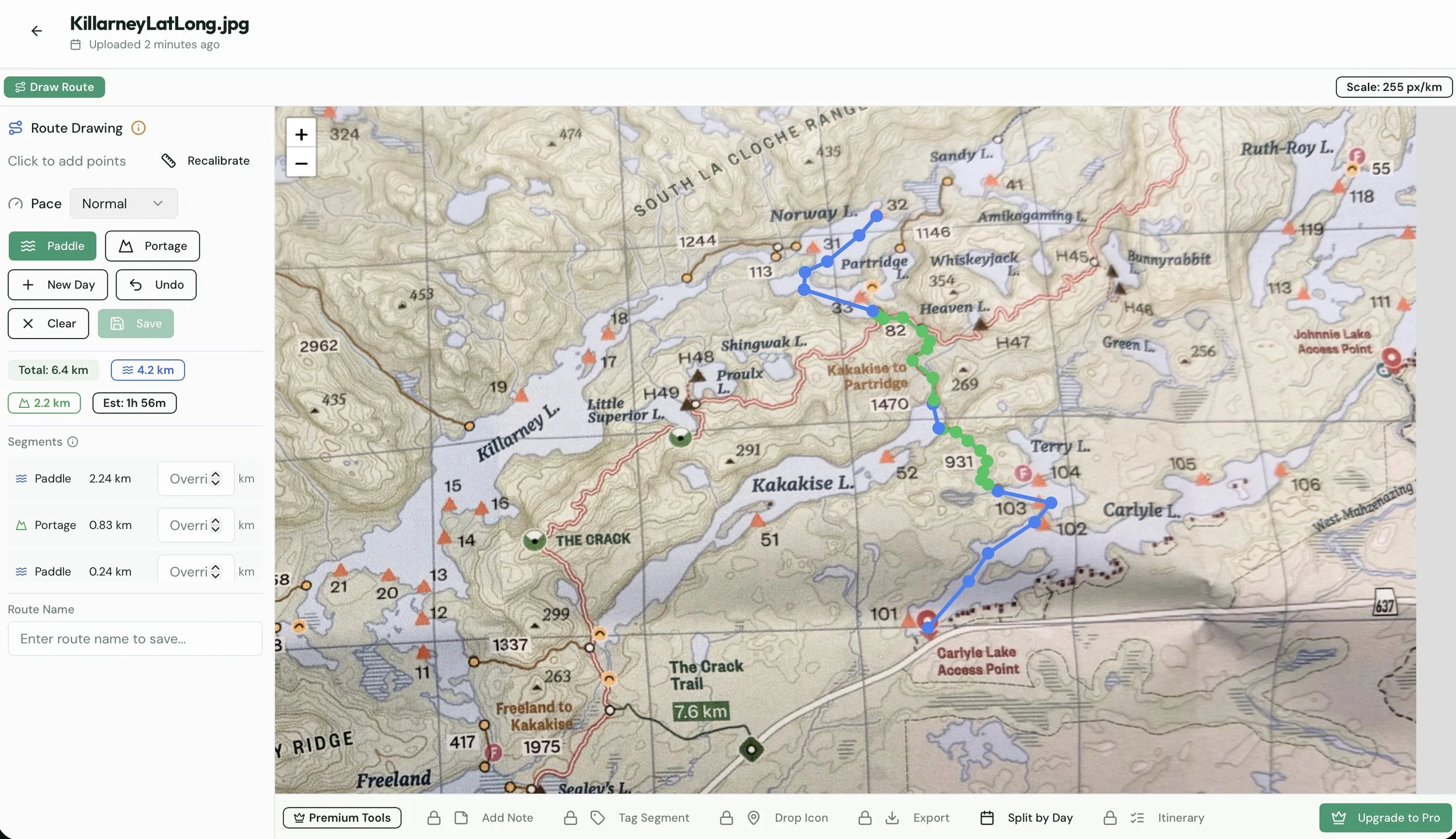
Entire websites are springing up now too. It was only a little while ago when resources for backcountry campers and canoeists was few and far between, but within this year alone we now have Map My Portage, Camp Claim, CampLog, Campsite App, Scree, and the oddly named SiteShame. These days A.I. is REALLY good at coding and if you have a decent idea, you can tell it what you want in simple English statements and it will churn out something that looks really professional (the process is known as vibe-coding). I’m not saying that the creators of each of these sites doesn’t know what they are doing, or have any part in the coding aspect, but it’s wild that things that would take ages to code, or beyond someones knowledge are now fast tracked and can be a reality.
On the flip side, trail discovery and planning app Komoot grew in popularity over the years. Recently it was bought by Bending Spoons, a company known for snapping up smaller companies, firing the majority of the staff and replacing them with their own staff alongside the help of significant A.I. coding. While they are releasing new features at a very brisk pace, a lot of features seem to be broken or older features are starting to fail. Maybe it just takes time for A.I. to improve the entirety of coding, but for the time being its left a very unstable app.
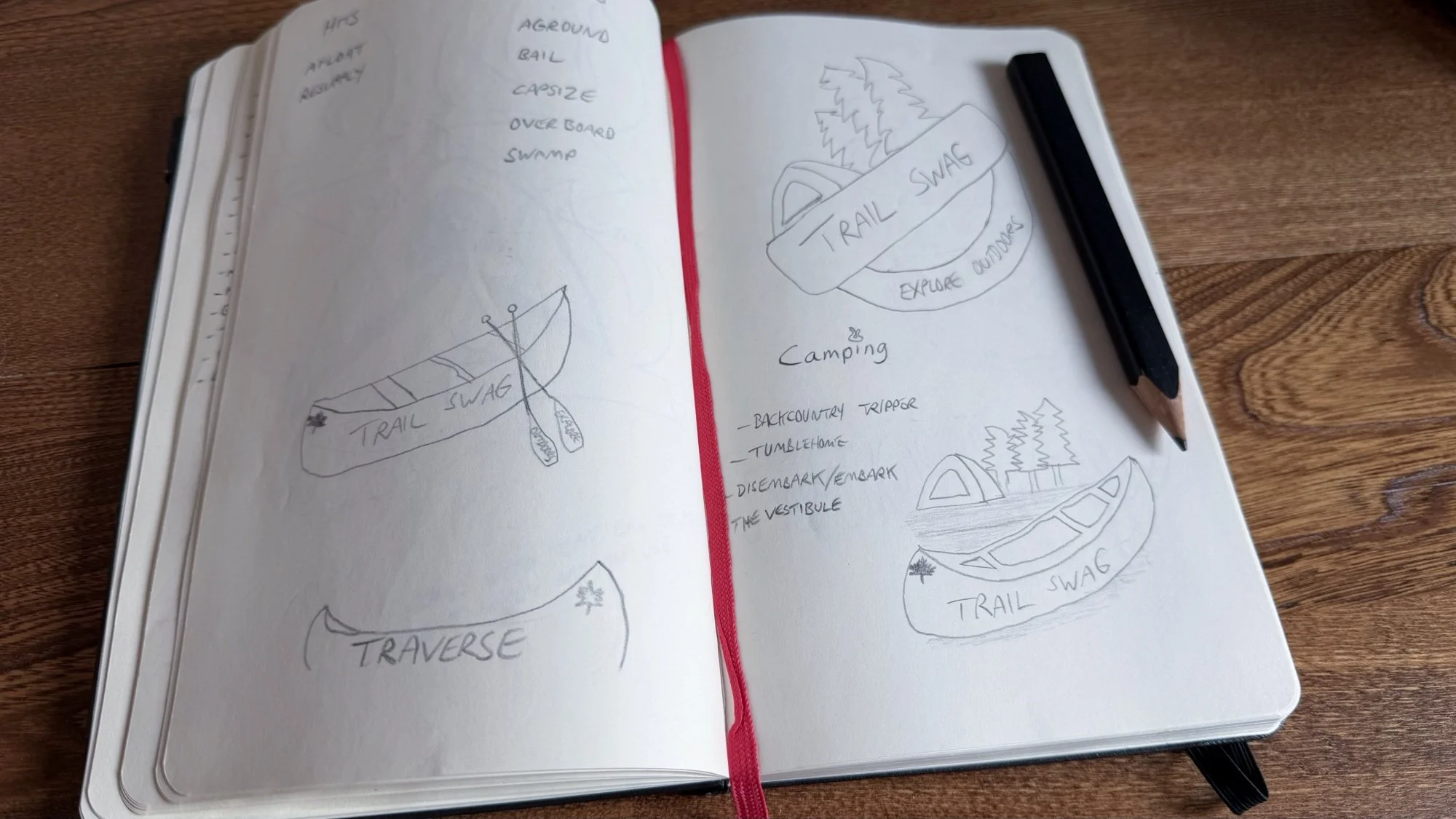
Actual sketches where I was tumbling around ideas for the logo as I rebranded Trail Swag into Traversing.
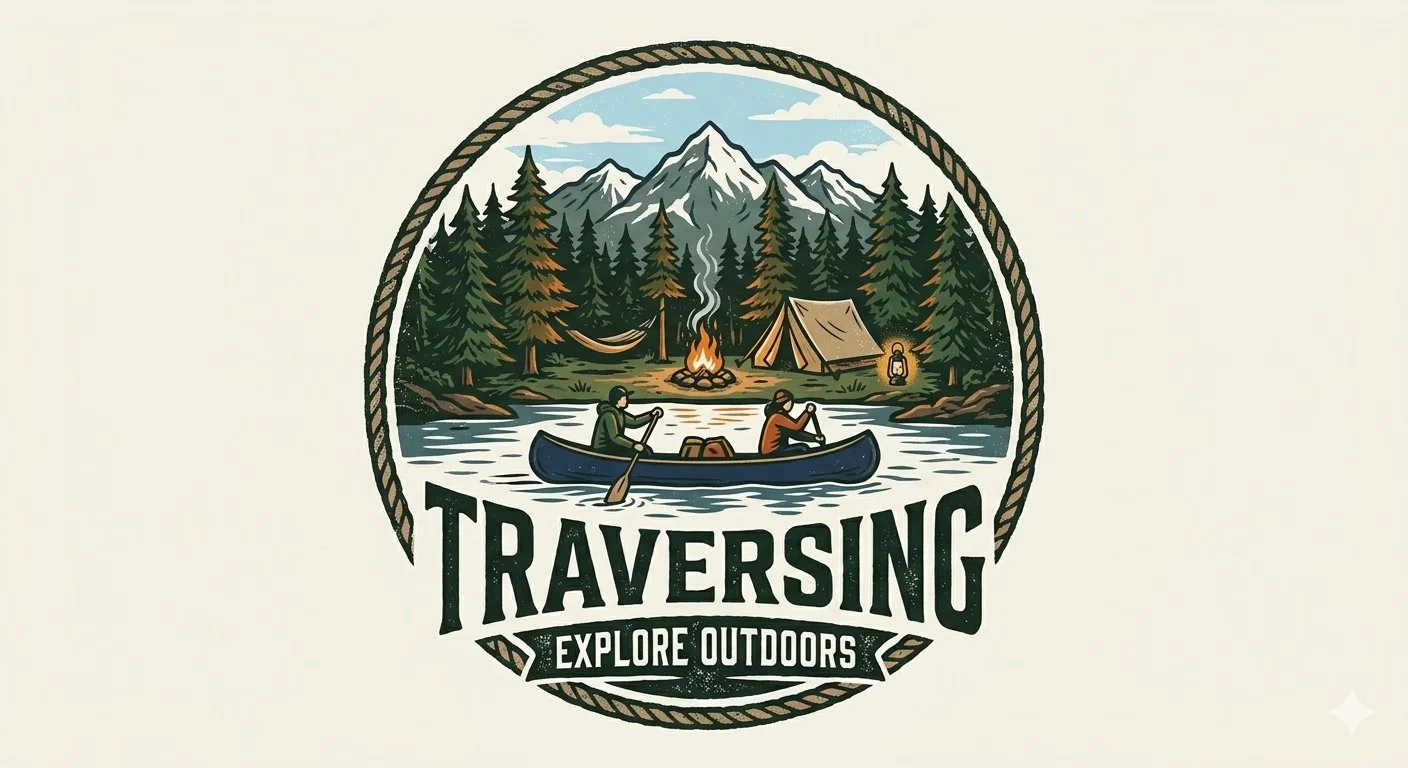
Finally, on another tangent, A.I. is also pretty solid at logo creation. I can’t tell you how long I spilt over ideas for a logo for my site, sketching up mock-ups in a moleskin notebook, then bringing my final logo to a graphic designer and paying them to create the Traversing logo as we all know and love it. Now, within seconds I can create a logo (not that I think A.I. has much actual design know-how) without paying a single cent.
I feel bad for graphic designers the world over, but hope that there are still people out there that recognize the importance of actual design. Plugging in the same details into A.I. spat out the following logo in minutes flat, which again I think pales in comparison but shows you the versatility and power of such a tool. Because it is so easy to use, I’ve seen countless websites selling camping gear with completely fake photos, which to me really lessens the impression of their commitment to quality.
All in all, A.I. is a tool and it’s accelerating and becoming better each and every day (although it has been three years and it still can’t render a photo of someone portaging). In the meantime use it wisely, always have a watchful eye as to what it creates or what you see online and maybe one day it will be so good that we’ll all be out of jobs and have more time for canoeing.
Trail Mix is an assortment of outdoors related blog posts that can be fun, quirky or just thought provoking.